
URBAN LIVING ROOMS
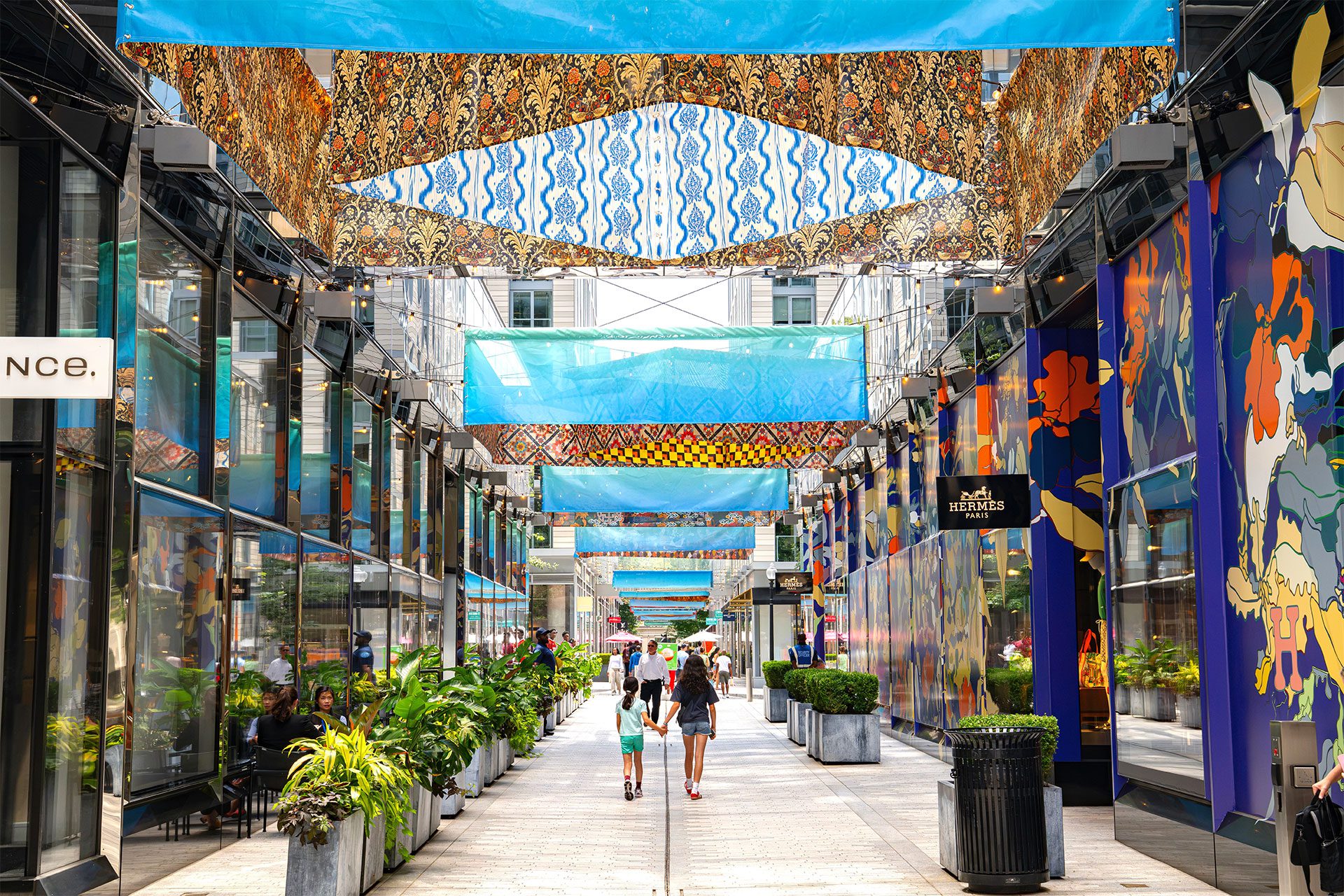
Urban Living Rooms embraces the idea that American style is not defined by a single aesthetic, but by the coexistence of many histories, traditions, and identities over the past 250 years. Across seventeen suspended “rooms”, the installation presents a glimpse of the artistic, cultural, and social influences that have shaped American life: from Indigenous traditions and early domestic crafts to immigration, industry, music, film, and contemporary culture.
The project begins with a simple premise: every American, whether born in the States or arriving from all over the world, is in some way an artist and curator of their own domestic environment. Through personal choices of furniture, objects, colors, textures, and decoration, people transform living spaces into expressions of identity, memory, aspiration, and belonging. The living room, in particular, serves as a stage where personal narratives become visible. It is a domestic communal space for gathering, hosting, celebrating, and sharing life with others, while simultaneously revealing individual tastes, cultural heritage, and ways of living.
By translating the living room into an urban setting, the project transforms a familiar domestic space into a collective public experience. Each suspended room becomes a cultural space, inviting visitors to move between distinct yet interconnected histories, aesthetics, and influences. Together, they create a spatial portrait of the United States as a place where diverse traditions exist alongside one another rather than within a single dominant narrative.
The installation views American style not as a fixed visual language but as an ongoing process of exchange, adaptation, and reinvention. Throughout the past 250 years, American culture has been continuously shaped by Indigenous knowledge, waves of migration, global influences, technological innovation, and regional traditions. The patterns and interiors referenced throughout the project reflect this layered history, drawing connections between domestic life and larger cultural movements. While the exterior of the installation presents a unified visual identity through a continuous blue-green gradient, the interiors reveal a multiplicity of voices, stories, and aesthetics expressed through seventeen distinct pattern environments. From a distance, the work appears cohesive and singular; upon closer interaction, it unfolds into a rich collection of individual narratives and cultural references.
CHAPTER ONE
Foundations:
Nation Building
Pre-1770s: Indigenous America (Room 1)
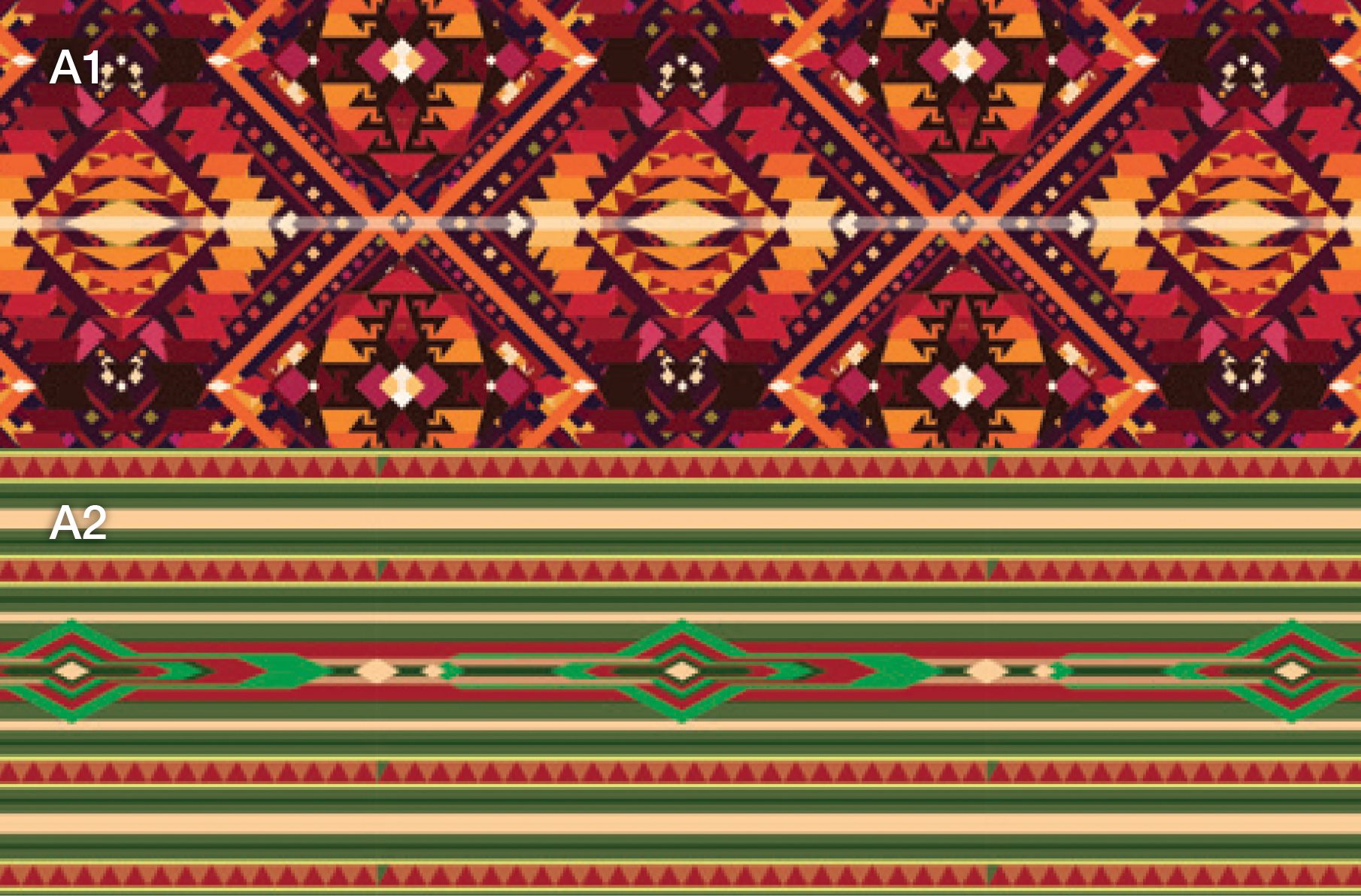
Before the founding of the United States, the continent was home to diverse Indigenous nations whose artistic traditions shaped the visual culture of North America for thousands of years. Drawing inspiration from woven textiles, beadwork, basketry, and pottery traditions, these patterns employ bold geometric forms, rhythmic repetition, and vibrant color palettes that reflect sophisticated systems of storytelling, cultural identity, and craftsmanship. Across many Indigenous communities, textiles and decorative objects served not only practical purposes but also carried symbolic meanings connected to family, place, trade, and spiritual beliefs.
These visual languages continue to influence American design today. Geometric motifs derived from Indigenous weaving traditions remain present in contemporary interiors, textiles, and furnishings throughout the Americas. By beginning the installation with these patterns, the project acknowledges the original stewards of the land and recognizes Indigenous cultures as the foundation of American visual and material culture.
1770s – 1830s: Early American & Federal Era (Room 2)
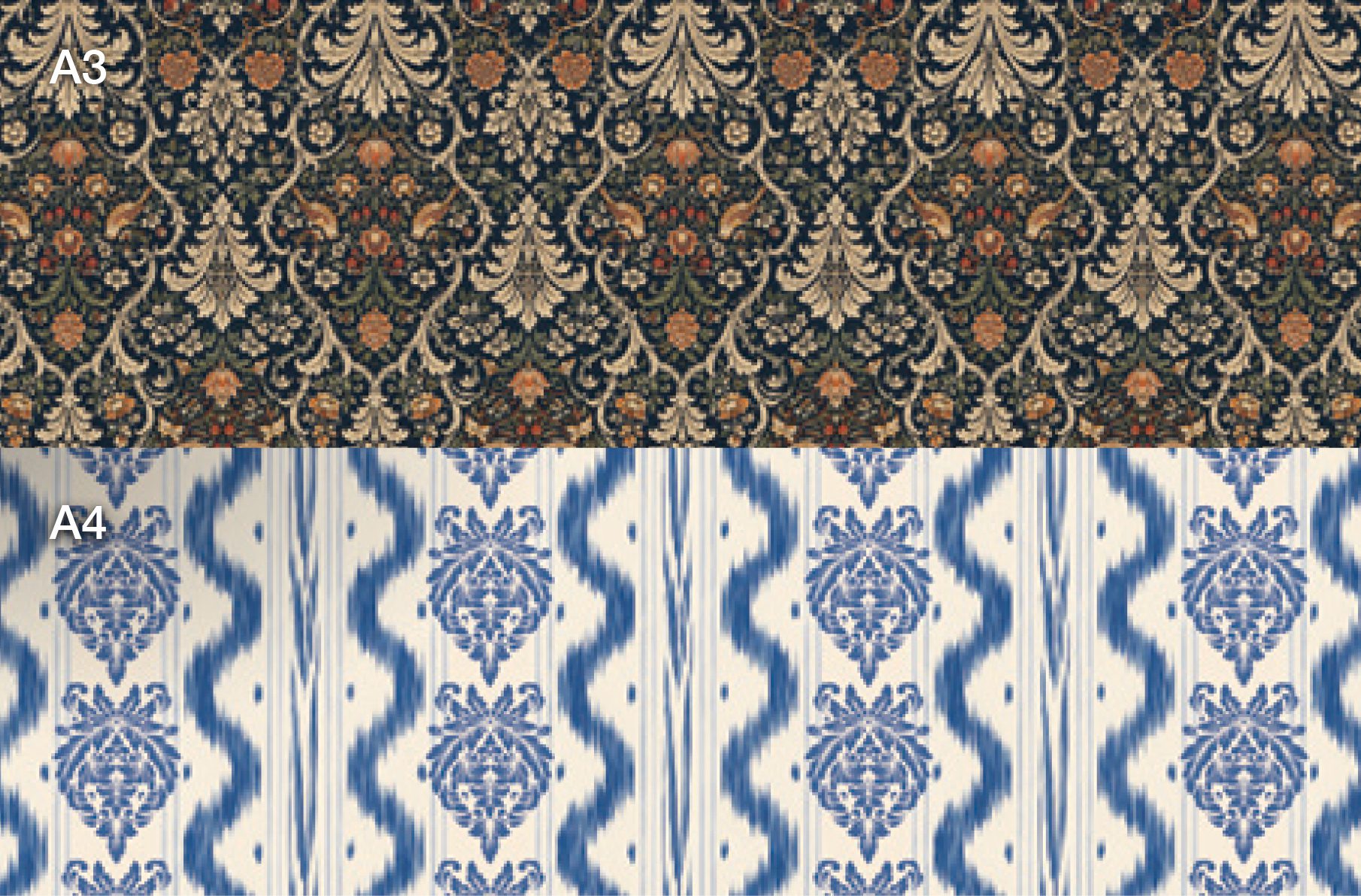
Following the American Revolution, the young nation sought to establish a visual identity rooted in ideas of order, permanence, and refinement. Inspired by European and Neoclassical traditions, domestic interiors emphasized symmetry, balance, and repeated ornamental motifs. Houses such as the Hottenstein House (1783) in Pennsylvania exemplify the architecture of this period, where handcrafted wallpapers, textiles, furniture, and decorative finishes contributed to carefully composed living spaces.
Patterns A3 and A4 reference the formal symmetry and repeated decorative elements commonly found in early American homes. Floral motifs, ornamental borders, and rhythmic arrangements reflected both the aspirations of a new nation and the growing importance of the home as a space for social gathering. During this period, the living room emerged as a place where family life, hospitality, and civic identity intersected, establishing many of the domestic traditions that would continue throughout the nineteenth century.
1800s – 1850s: Rural America & Quilt Traditions (Room 3)
As the United States expanded westward, rural houses became one of the defining forms of American domestic life. Publications such as Asher Benjamin’s The Country Builder’s Assistant (1797) provided builders with standardized architectural details and pattern books that helped shape homes across the growing nation. While architecture established the framework of the house, quilts became one of the most significant artistic expressions within it.
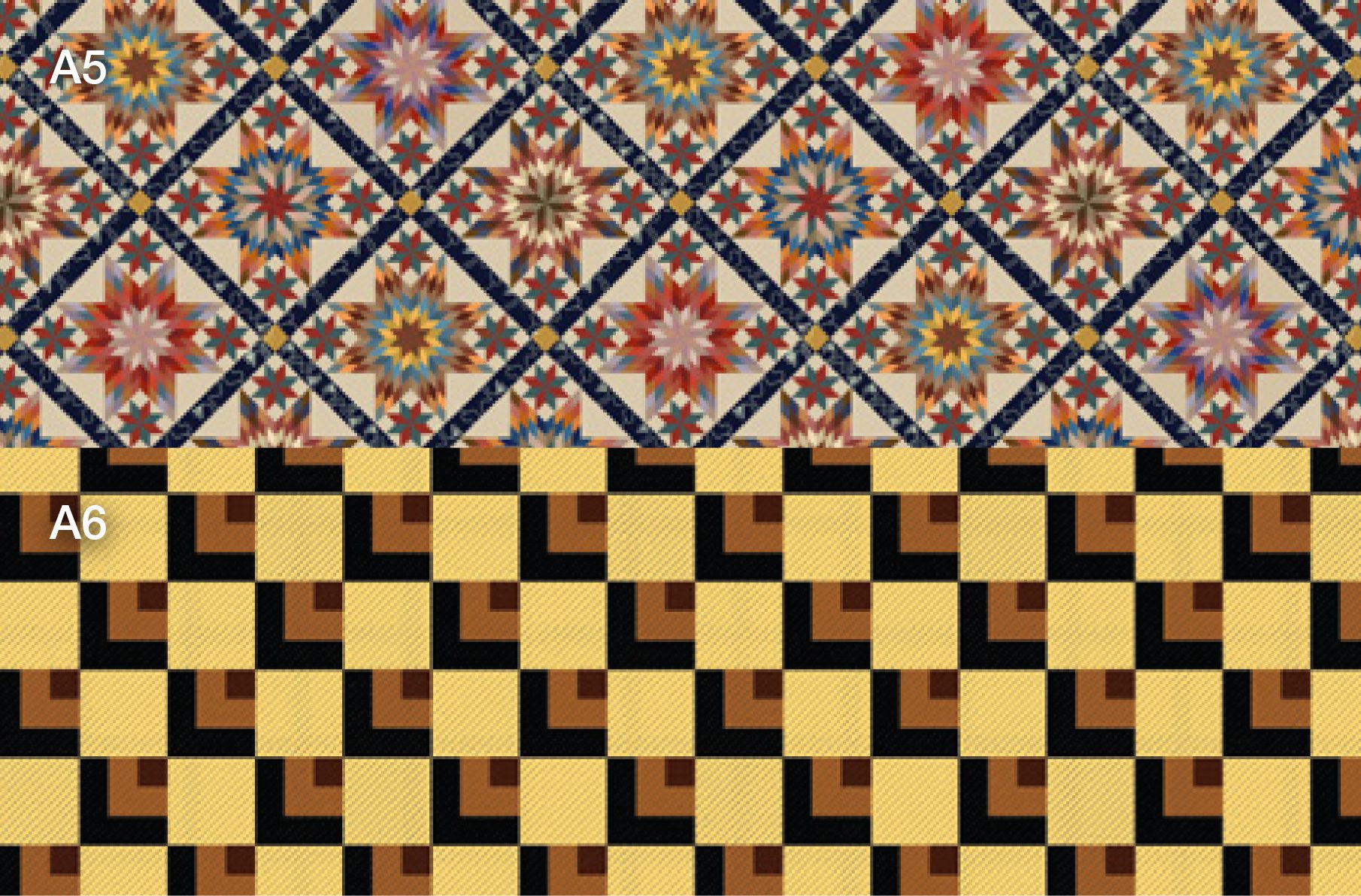
Quilting traditions transformed scraps of fabric into intricate geometric compositions that conveyed family histories, regional identities, and collective memory. During the mid-nineteenth century, quilts were often created through communal gatherings where stories, skills, and traditions were shared across generations. Pattern A5 draws from the colorful geometry of American quilt blocks, while Pattern A6 references simpler repeating arrangements common in everyday domestic textiles.
Some historians have also associated quilt patterns with oral traditions connected to the Underground Railroad, symbolizing ideas of movement, refuge, and freedom. Whether functional, decorative, or symbolic, quilts remain one of the most enduring forms of American folk art and a powerful representation of home, care, and community.
1850s – 1870s: California Gold Rush & Immigration (Room 4)
The California Gold Rush transformed the United States economically, culturally, and demographically. Beginning in 1848, the discovery of gold attracted migrants from around the world, including large numbers of immigrants from China, Latin America, Europe, and Australia. These communities brought with them artistic traditions, materials, and decorative practices that would become woven into the fabric of American life.
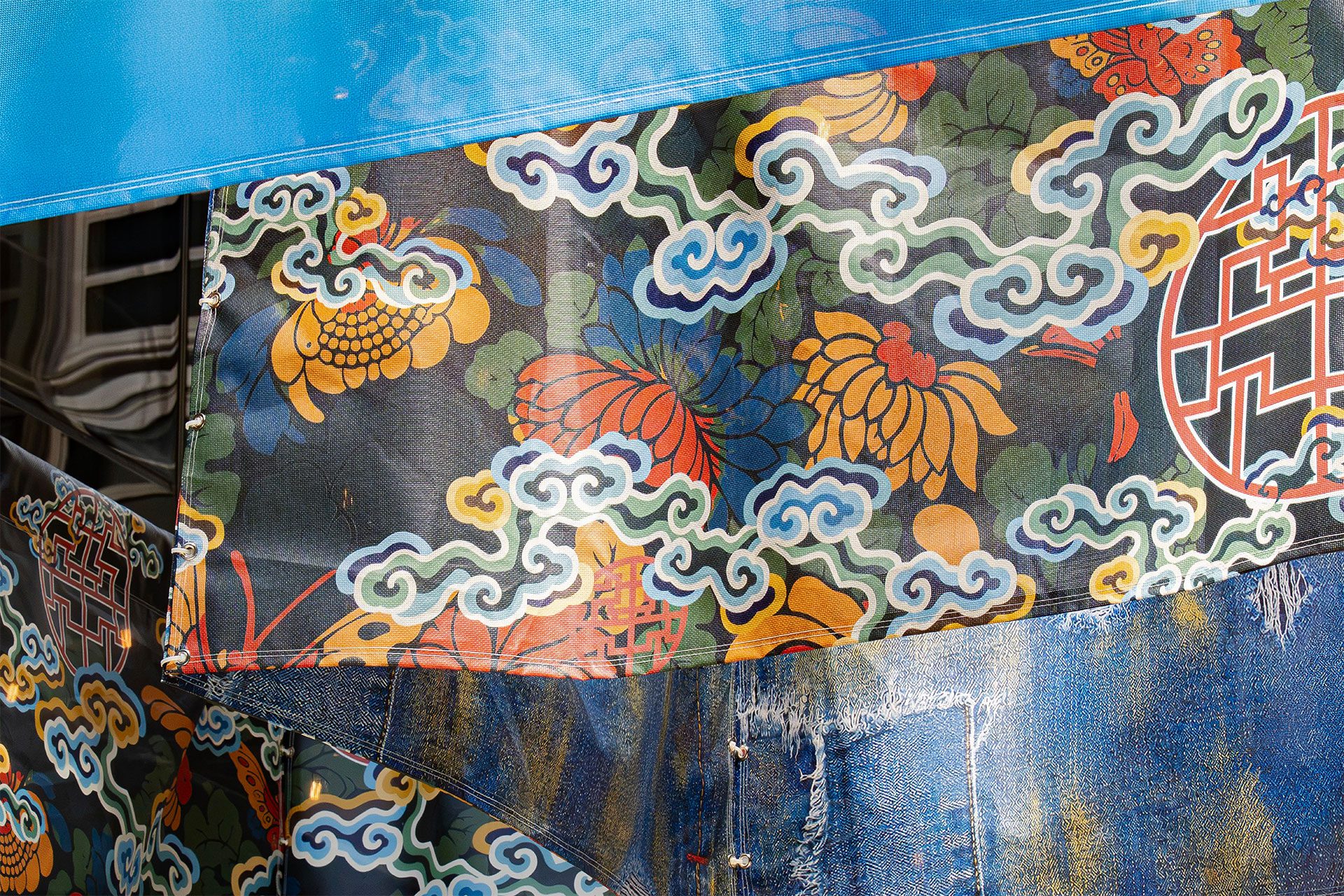
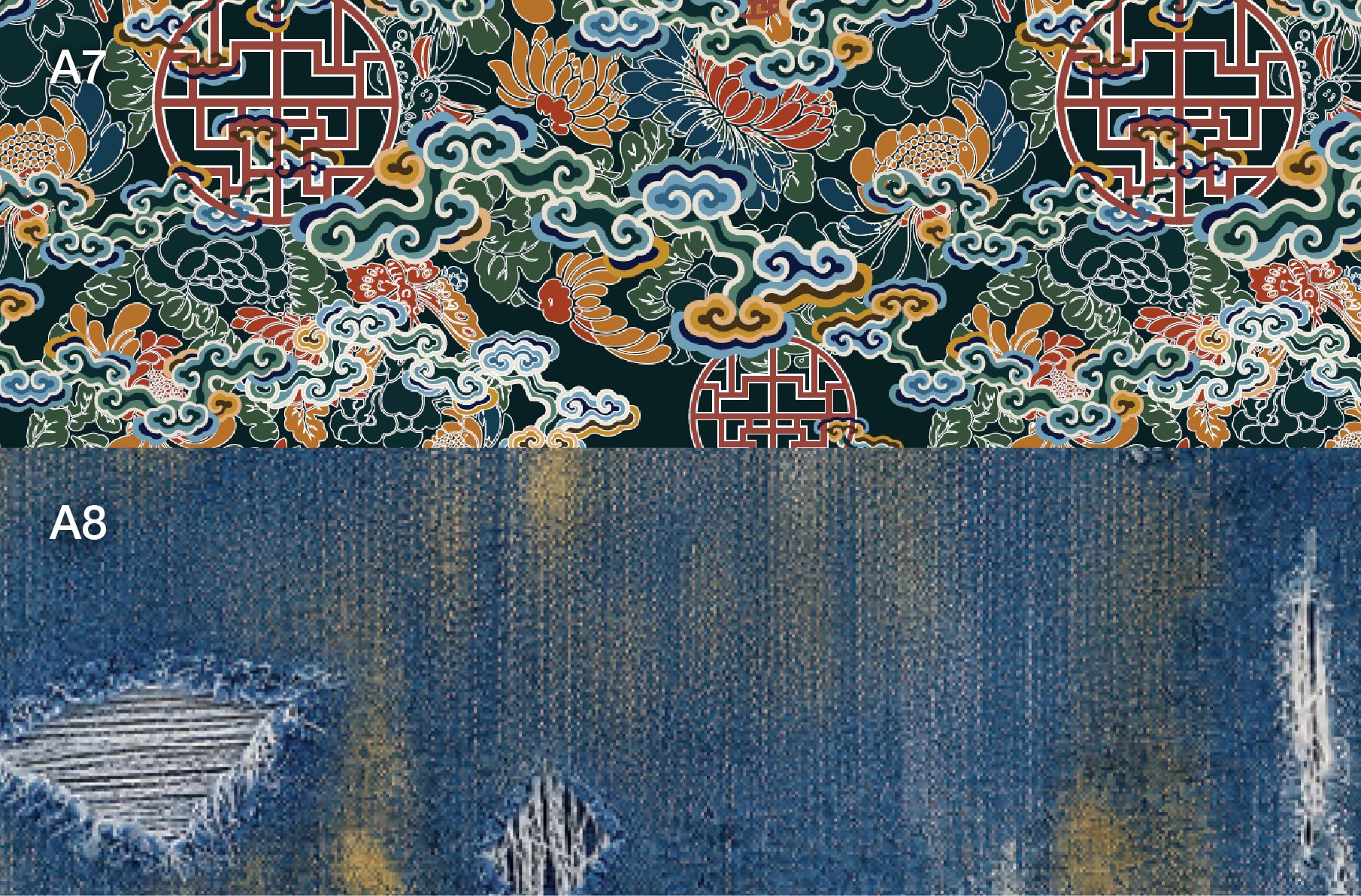
Pattern A7 draws inspiration from East Asian decorative arts, incorporating motifs such as clouds, florals, and ornamental forms commonly found in textiles, ceramics, screens, and architectural details. Chinese porcelain, lacquerware, silk textiles, and decorative objects became increasingly present within American homes, particularly in parlors and dining rooms where imported goods symbolized global connections and cultural exchange.
In contrast, Pattern A8 references denim—a material born from the practical needs of labor during the Gold Rush era. In 1853, immigrant entrepreneur Levi Strauss established his business in San Francisco, and in 1873, together with tailor Jacob Davis, patented the riveted work pants that would become the modern blue jean. The juxtaposition of ornate decorative traditions with the rugged texture of denim reflects two parallel narratives of American history: cultural migration and industrial innovation. Together, these patterns celebrate a nation shaped by both native peoples and generations of immigrants who contributed to its cultural and economic development.
1880s: Motion, Industry & Modern Vision (Room 5)
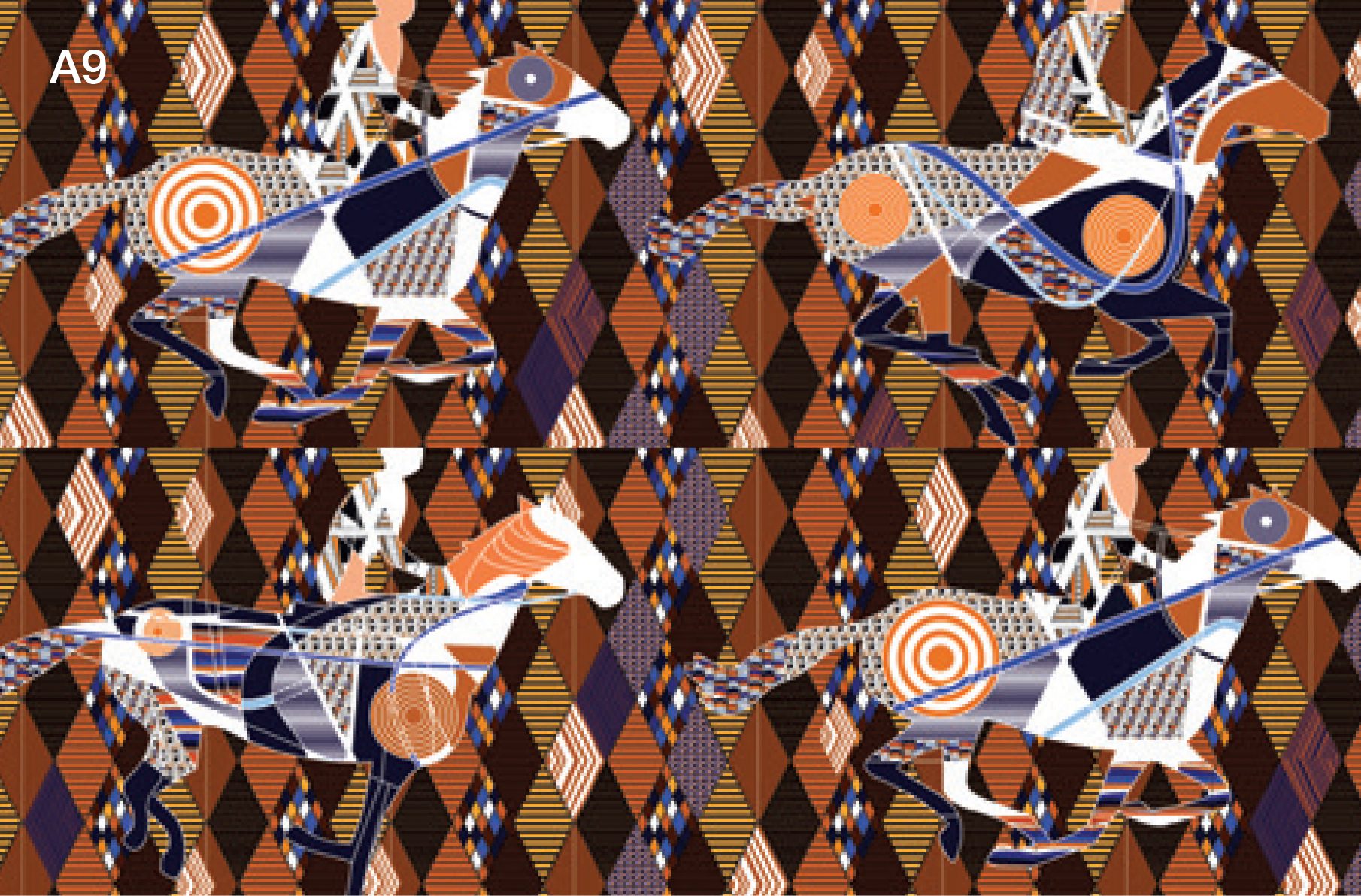
Pattern A9 celebrates one of the most influential technological and artistic breakthroughs of the nineteenth century: the study of motion through sequential photography. In the 1870s and 1880s, photographer Eadweard Muybridge conducted groundbreaking experiments in California that captured the movement of horses and human figures frame by frame. His work demonstrated, for the first time, that motion could be analyzed through a sequence of images, laying the foundation for modern cinema, animation, and photographic studies of movement.
The fragmented figures within the pattern reference Muybridge’s iconic motion studies while also reflecting the accelerating pace of industrial America during the late nineteenth century. The geometric background draws inspiration from decorative arts and textiles of the period, while the color palette references influential works such as Harmony in Yellow and Gold: The Gold Girl and decorative screens produced through collaborations between American designers and global craft traditions, including the work of Lockwood de Forest and the Ahmedabad Wood Carving Company.
As American homes became increasingly connected to new technologies, mass production, and global trade, the living room evolved into a space where art, invention, and modern life converged. This pattern captures a pivotal moment when movement itself became a subject of artistic fascination and a symbol of a rapidly changing nation.
CHAPTER TWO
MODERNITY:
Cultural Transformation
Late 1800s – Early 1900s: Prairie School, Arts & Crafts & Art Nouveau (Room 6)
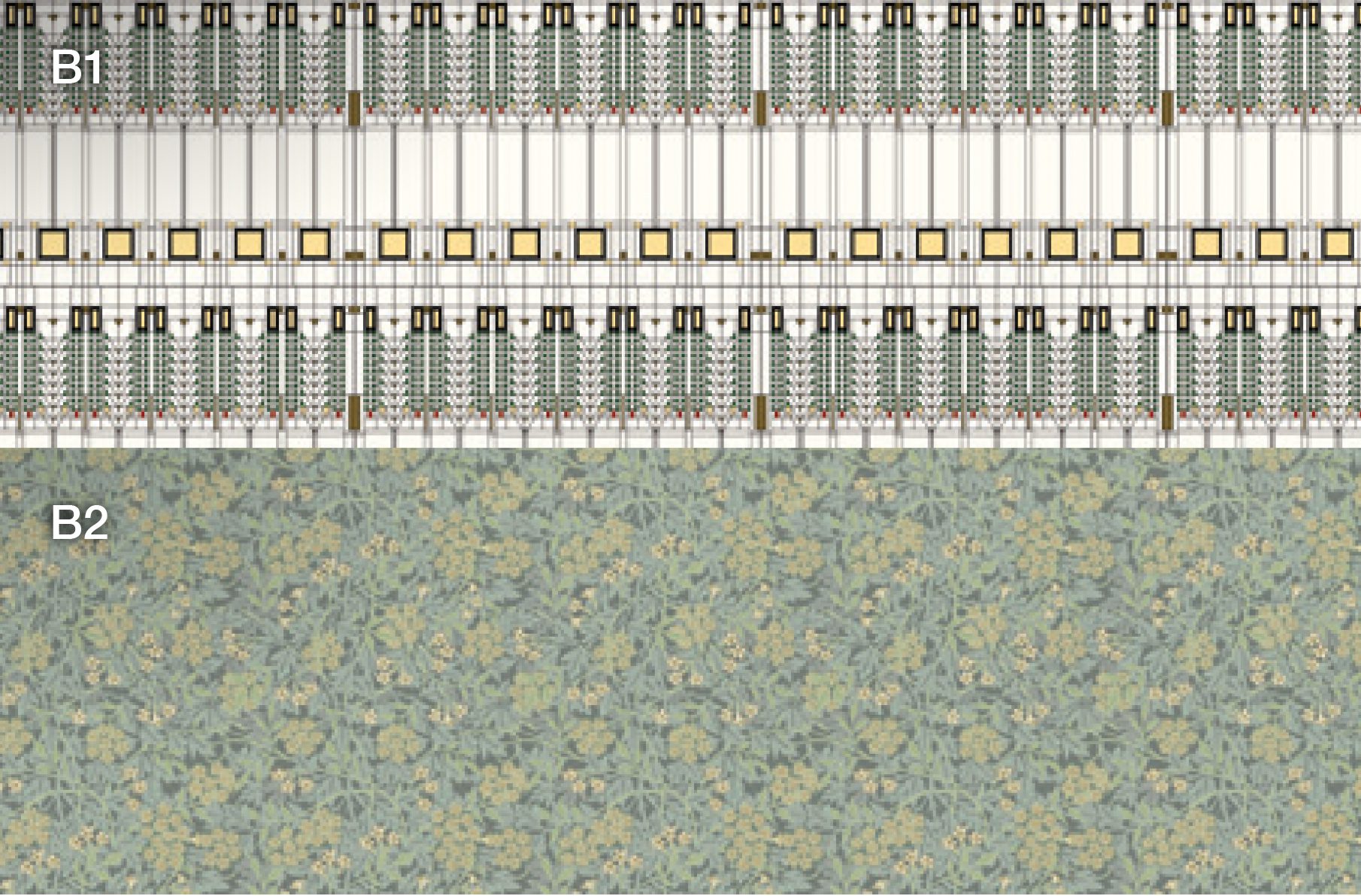
At the turn of the twentieth century, American architecture and interior design began developing a distinct identity. Pattern B1 draws inspiration from the geometric leaded-glass windows and decorative screens of Frank Lloyd Wright’s Prairie School houses. Through layered grids, symmetry, and abstracted natural forms, the pattern reflects Wright’s belief that architecture, furniture, ornament, and landscape should exist as a unified whole. The home was envisioned as a carefully composed environment where every detail contributed to daily life.
In contrast, Pattern B2 references the softer floral motifs and handcrafted traditions of the Arts & Crafts and Art Nouveau movements. Inspired by the work of designers such as William Morris, Arthur Wesley Dow, and Charles Rohlfs, the pattern celebrates nature, craftsmanship, and the decorative arts. Together, these two patterns capture a moment when American homes became laboratories for artistic experimentation, blending architecture, furniture, textiles, and ornament into cohesive living environments.
1910s – 1930s: The Jazz Age & Art Deco (Room 7)
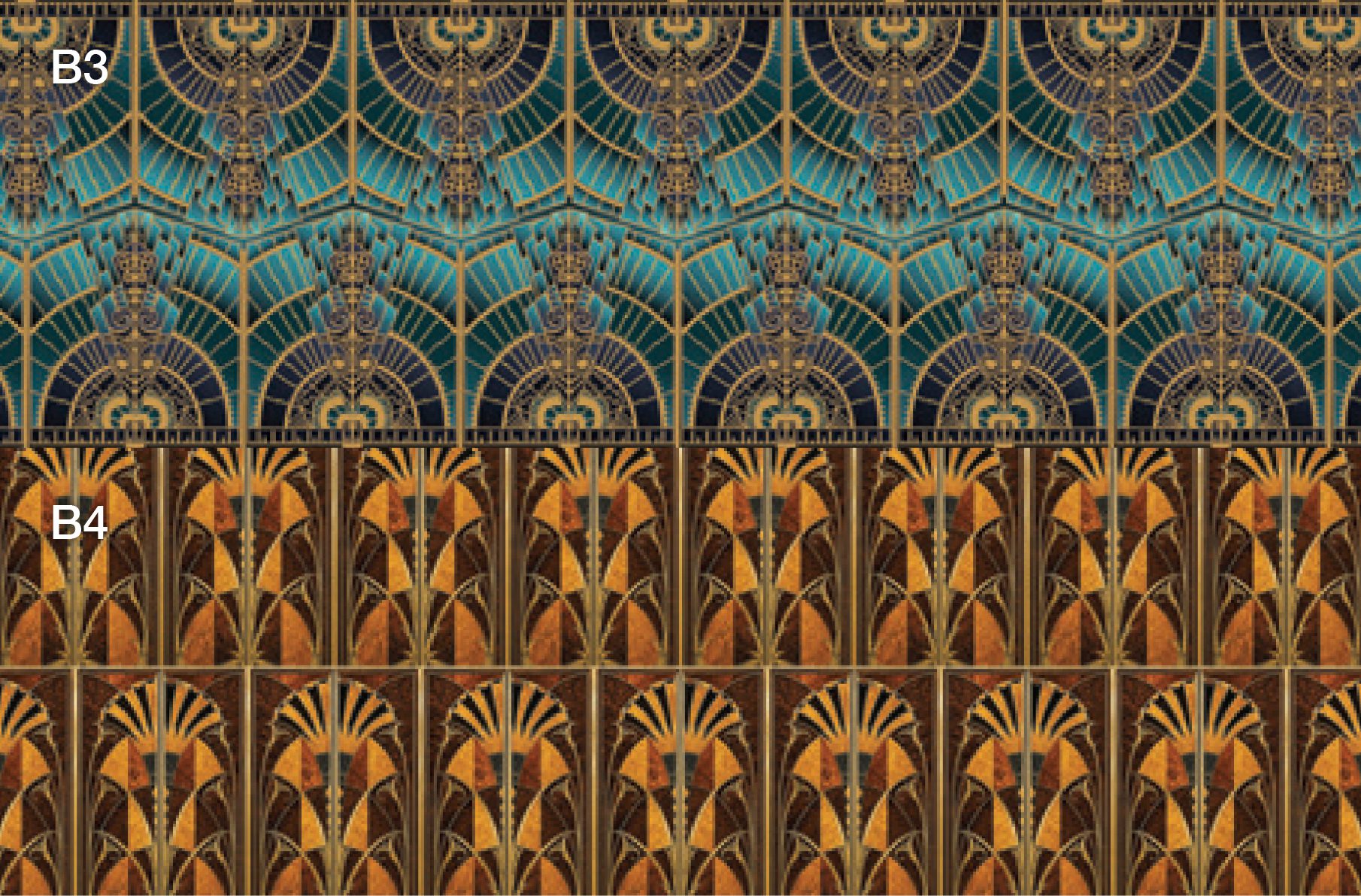
The prosperity and optimism of the Jazz Age transformed American cities and interiors alike. Art Deco emerged as the defining style of the era, celebrating modernity, luxury, and technological progress. Pattern B3 incorporates bold geometric forms, radiating lines, and rhythmic repetition, draws inspiration from decorative ironwork, theater interiors, and the geometric ornamentation of New York’s skyscrapers, incorporating radiating forms, metallic tones, and symmetrical compositions associated with the Machine Age.
This era also reflects a period when American homes embraced glamour, sophistication, and machine-age aesthetics. Living rooms became spaces for entertainment, music, and social gathering, mirroring the energy and ambition of rapidly growing cities. Pattern B4 references the stylized botanical motifs details drawn from lacquered furniture and interiors designed by figures such as William Van Alen. The patterns capture the excitement of a nation looking toward the future while establishing one of the most recognizable visual styles in American design history.
1920s – 1930s: Harlem Renaissance & The Great Migration (Room 8)
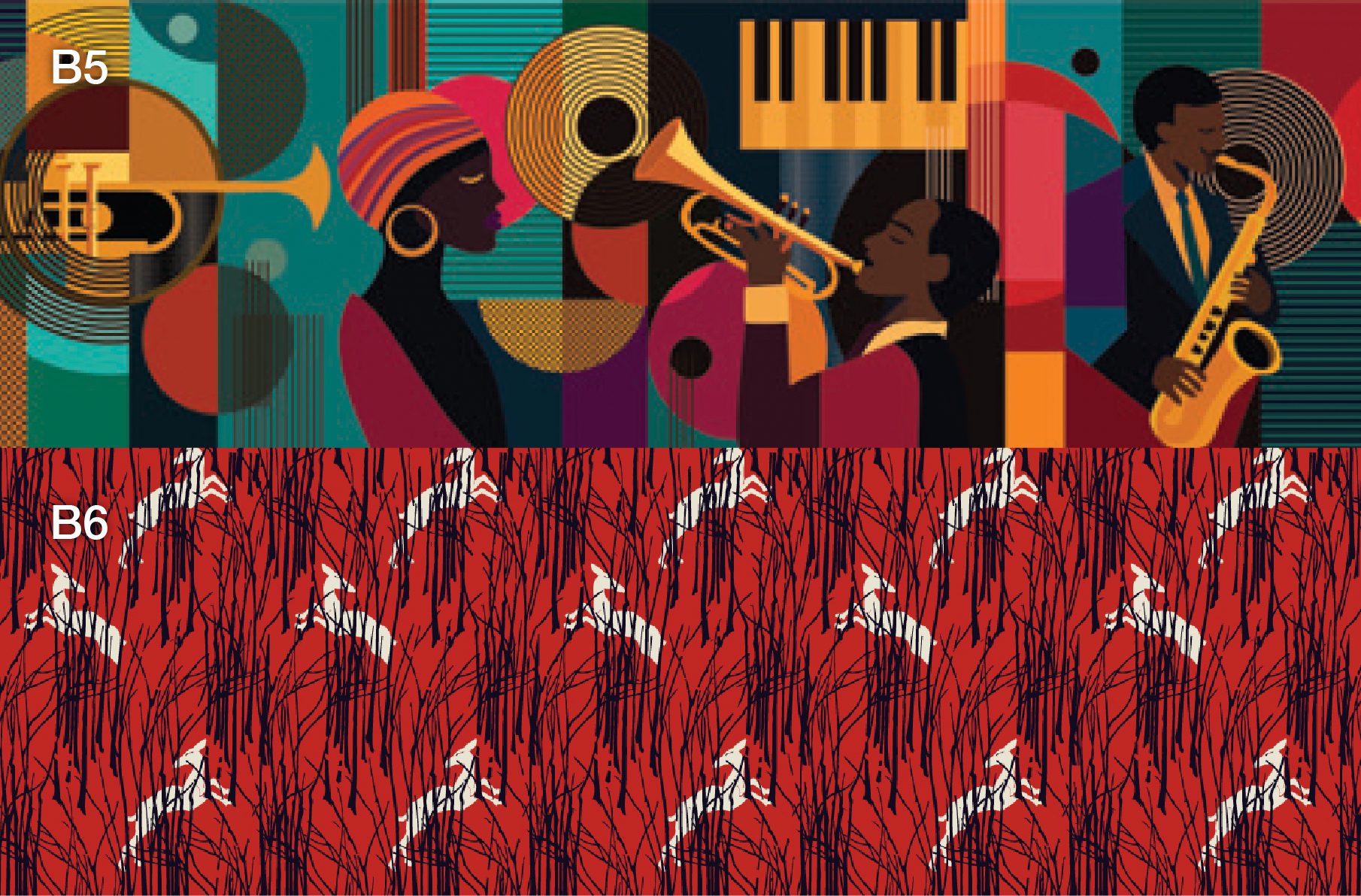
The Harlem Renaissance stands as one of the most influential cultural movements in American history. Fueled by the Great Migration of African Americans from the rural South to northern cities, the movement transformed American literature, visual art, music, and performance. Pattern B5 draws inspiration from the vibrant compositions and layered silhouettes of Aaron Douglas while celebrating jazz as one of America’s most significant cultural contributions. Musical instruments, rhythmic geometries, and bold colors reflect the improvisational energy of the era.
Pattern B6 explores the role of interior design and decoration as expressions of identity and cultural aspiration. Drawing inspiration from Scalamandré’s iconic Zebra wallpaper, first created in the 1940s and later reintroduced to new generations through film, fashion, and popular culture, the pattern celebrates the lasting influence of decorative arts within American interiors, such as Wes Anderson’s movie The Royal Tenenbaums. Much like the living room itself, wallpaper functions as a form of self-expression, transforming domestic space into a reflection of personal taste and cultural memory. Together, the two patterns highlight how music, art, and interior design have contributed to the rich and evolving character of American life.
1930s – 1940s: Social Realism, Migration & The American City (Room 9)
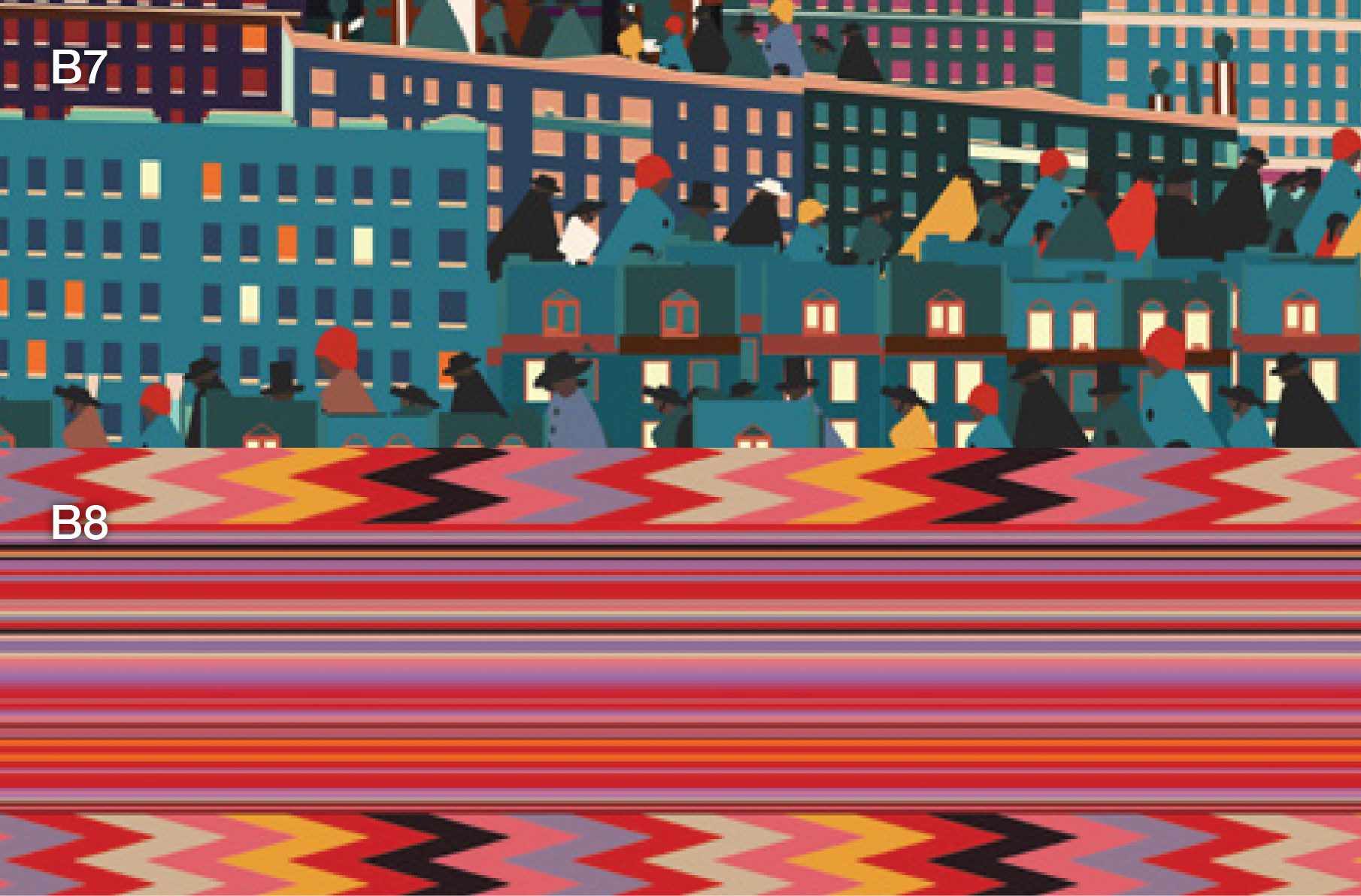
During the Great Depression, artists increasingly focused on the realities of everyday American life. Inspired by the work of Grant Wood, Stuart Davis, and particularly Jacob Lawrence’s Migration Series, these patterns reflect the movement of millions of Americans seeking new opportunities in expanding industrial cities.
Pattern B7 layers references to brownstones, apartment buildings, streets, transit systems, and urban infrastructure into a dense visual landscape that recalls the growing neighborhoods of New York, Chicago, Detroit, and other metropolitan centers. Pattern B8 introduces a series of rhythmic bands and directional geometries that suggest movement, transportation corridors, railroad lines, and migration routes. Together, the patterns capture a period when mobility, urbanization, and community formation were reshaping both American cities and American identity.
1950s: Abstract Expressionism, Modernism & The Postwar Home (Room 10)
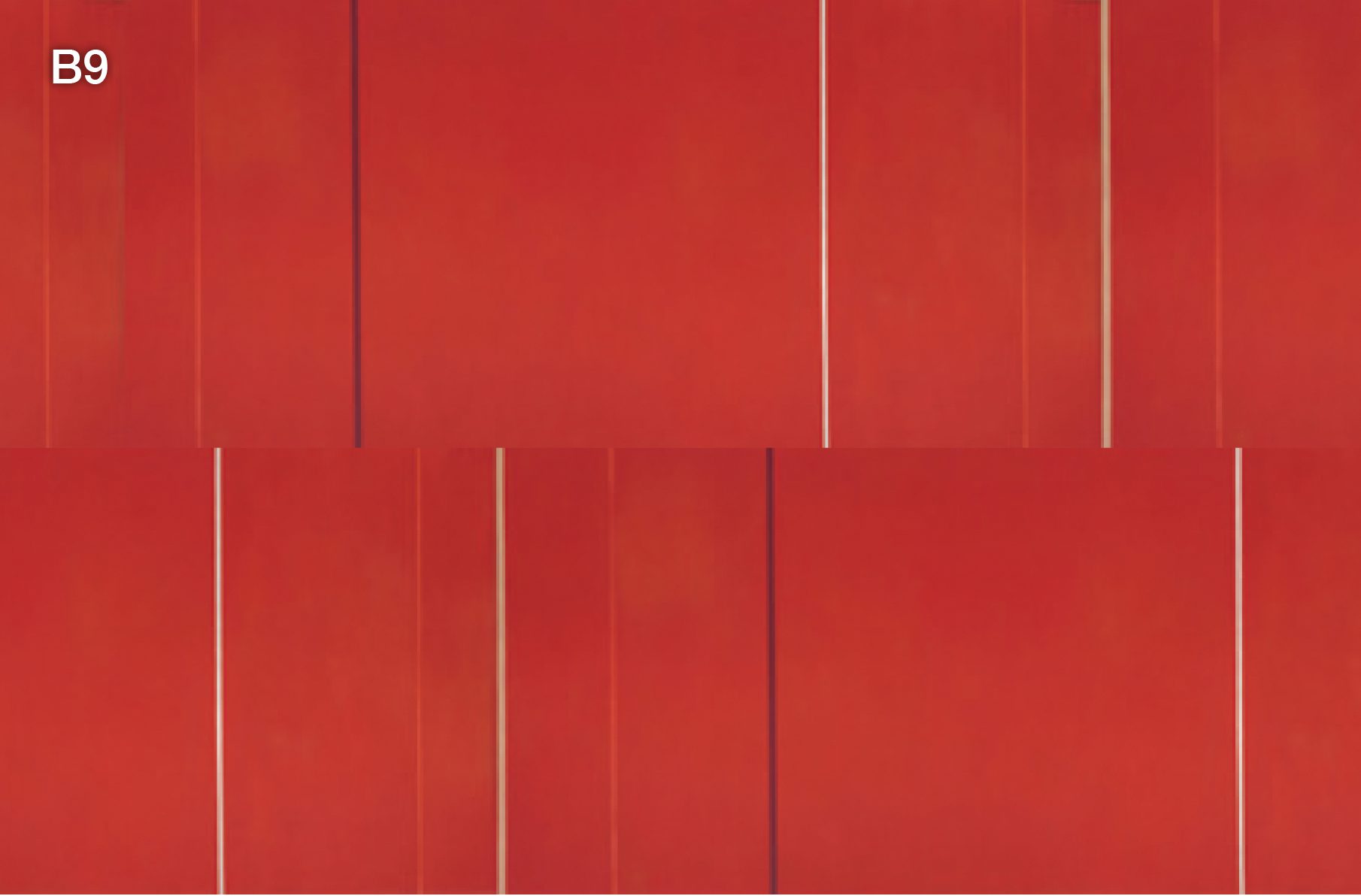
Following World War II, New York emerged as a global center of contemporary art, and Abstract Expressionism became one of the first internationally recognized American art movements. Inspired by the luminous color fields of Mark Rothko, this room introduces a moment of stillness within the larger installation. Soft transitions of color create an atmosphere of contemplation and reflection, inviting visitors to pause within an otherwise visually dynamic environment.
The pattern also reflects broader postwar ideas of modern living, including open plans, simplified forms, and the optimism associated with the Case Study House program. Within the sequence of seventeen living rooms, this space serves as a visual and emotional resting point.
1950s – 1960s: Minimalism, Industrial Materials & Material Honesty (Room 11)
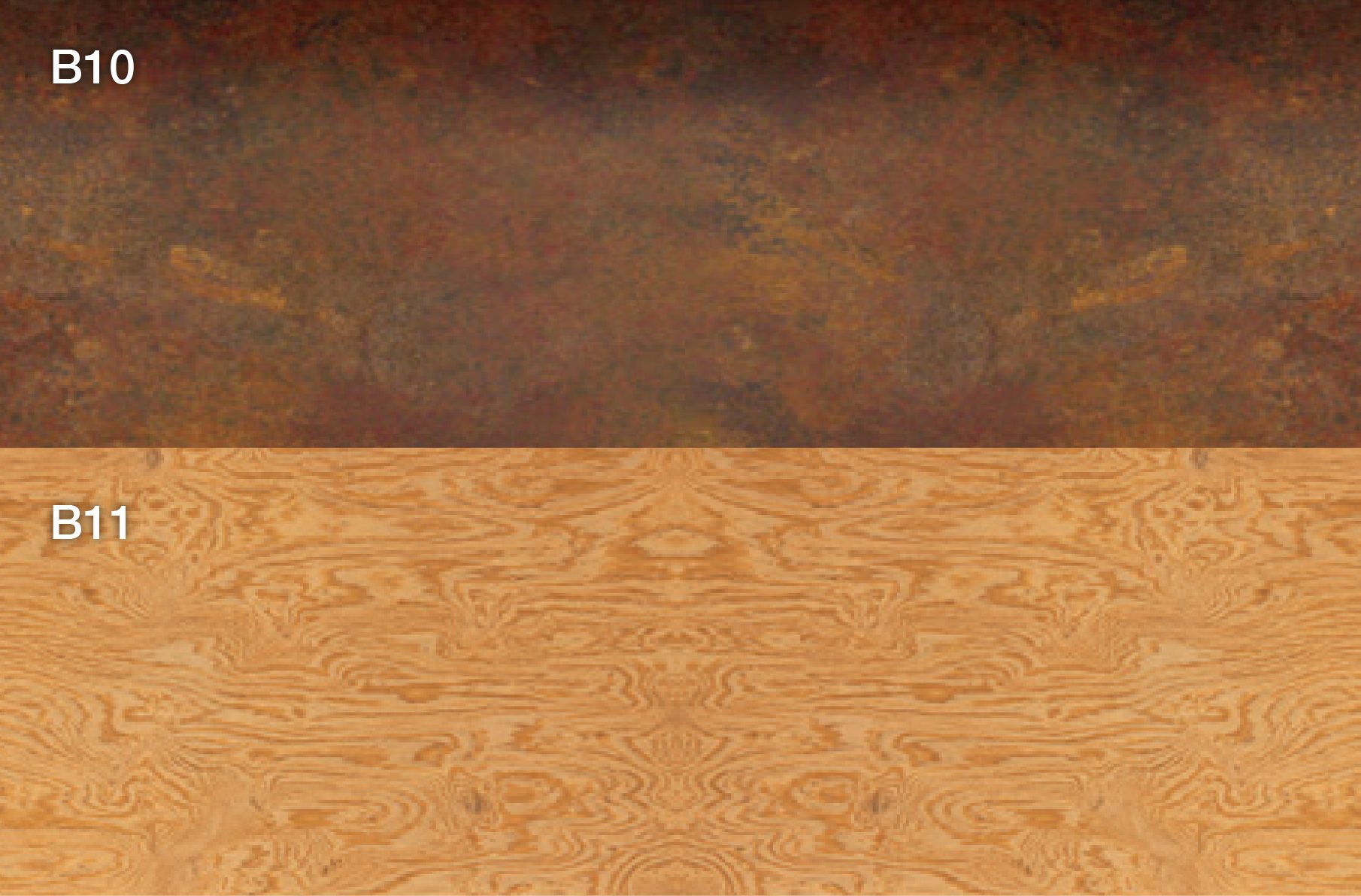
By the 1960s, many American artists and designers began stripping away ornamentation in favor of pure form, industrial fabrication, and direct material expression. Inspired by artists such as Donald Judd and Richard Serra, these patterns celebrate the beauty of ordinary materials and the processes that shape them.
Pattern B10 references weathered steel surfaces and the rich patinas that develop over time, while Pattern B11 draws inspiration from exposed plywood grain and construction materials frequently used in modern furniture, architecture, and sculpture. During this period, industrial materials increasingly became aesthetic features rather than elements to conceal. These patterns reflect a distinctly American fascination with experimentation, fabrication, and the elevation of everyday materials into art and design.
1970s – 1980s: Immigration, Global Influences & American Domestic Life (Room 12)
American style has continually evolved through successive waves of immigration, with each generation contributing new traditions, aesthetics, and ways of living. During the late twentieth century, growing communities from the Middle East, South Asia, Africa, and other regions brought rich decorative traditions that became woven into the fabric of American domestic life.
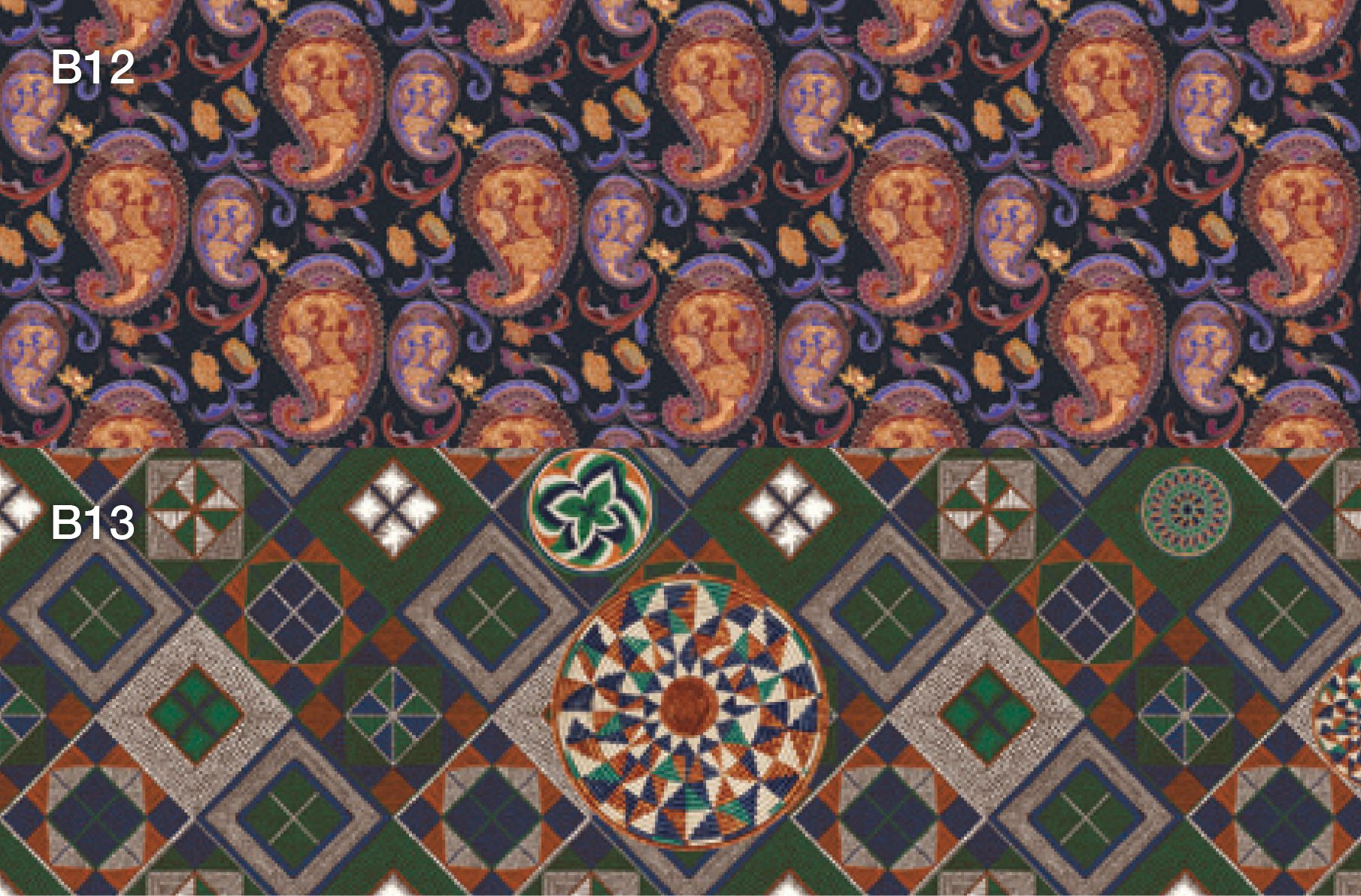
Pattern B12 draws inspiration from Persian textiles and the iconic paisley motif, a design that has traveled across cultures and continents for centuries. Pattern B13 incorporates references to geometric tilework, woven textiles, ornamental craft traditions, and decorative arts found throughout immigrant communities. Appearing in rugs, upholstery, wall hangings, ceramics, and household objects, these visual traditions became familiar elements within American homes. Together, the patterns celebrate the living room as a place where cultural heritage is preserved, shared, and integrated into the evolving story of American identity.
CHAPTER THREE
Remix: Community & Contemporary Identity
1950s – 1960s: Pop Art & Mass Culture (Room 13)
Emerging during the postwar boom, Pop Art challenged traditional distinctions between fine art and popular culture. Artists such as Andy Warhol and Roy Lichtenstein drew inspiration from advertisements, comic books, consumer products, and mass media, transforming everyday imagery into iconic works of art. Their work reflected both the optimism and contradictions of a rapidly expanding consumer society while helping establish a distinctly American visual language.
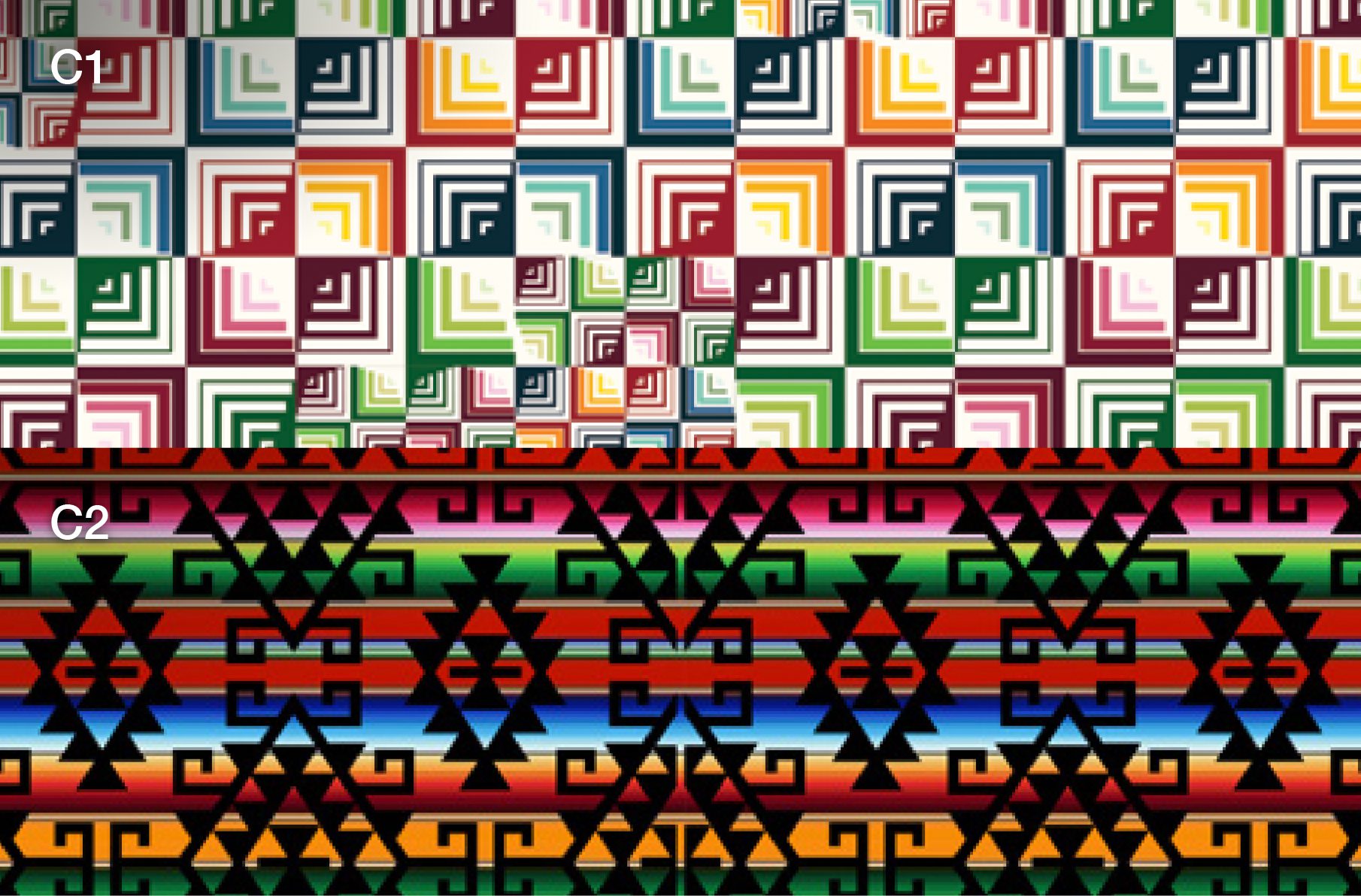
Pattern C1 offers a contemporary interpretation of Pop Art through the use of bold primary colors, circular motifs, graphic repetition, and layered geometries. Inspired by the visual vocabulary popularized by Pop artists, the pattern transforms familiar graphic devices into a dynamic composition that shifts between abstraction and representation. The resulting environment captures the energy, optimism, and visual intensity that defined postwar American culture while demonstrating Pop Art’s enduring influence on contemporary design, interiors, and visual communication.
1970s: Quilt Revival, Community & Cultural Exchange (Room 14)
Throughout American history, quilts have served as both functional objects and powerful forms of artistic expression. While quilting traditions date back centuries, public perception shifted dramatically during the 1970s following influential exhibitions such as Abstract Design in American Quilts at the Whitney Museum of American Art in 1971 and the landmark 1975 exhibition at New York’s Kornblee Gallery. These exhibitions revealed the remarkable abstraction, geometry, and visual sophistication embedded within quilting traditions long practiced in American homes, elevating quilts from domestic craft to recognized works of art.
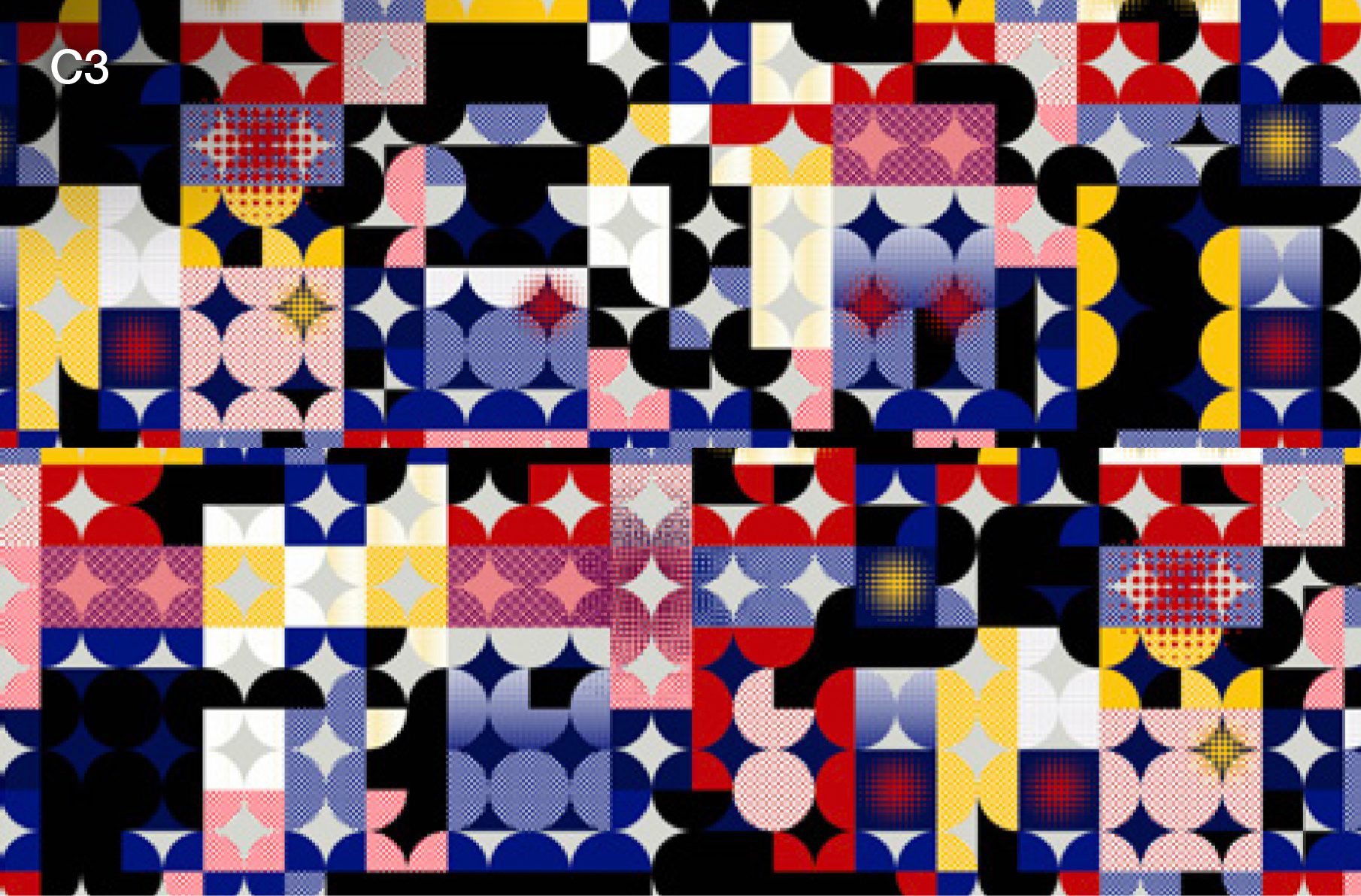
Pattern C2 draws inspiration from the Log Cabin quilt, one of the most recognizable quilt patterns in American history. Constructed from repeated geometric units, the pattern reflects ideas of home, shelter, family, and community. Quilting was often a collective activity, bringing neighbors and families together through quilting circles where stories, skills, and traditions were shared across generations. The pattern celebrates these acts of care, collaboration, and communal making that have long been central to American domestic life.
Pattern C3 draws inspiration from the vibrant textile traditions of Latin America, particularly the geometric motifs, woven structures, and bold color palettes found throughout Indigenous and Andean craft traditions. These visual languages have traveled across borders through migration, trade, and cultural exchange, becoming familiar elements within American homes and communities. Together, the two patterns celebrate the living room as a place where heritage, memory, and community are preserved, shared, and reinterpreted across generations.
Late 20th Century: Latin American Influences & Domestic Ornament (Room 15)
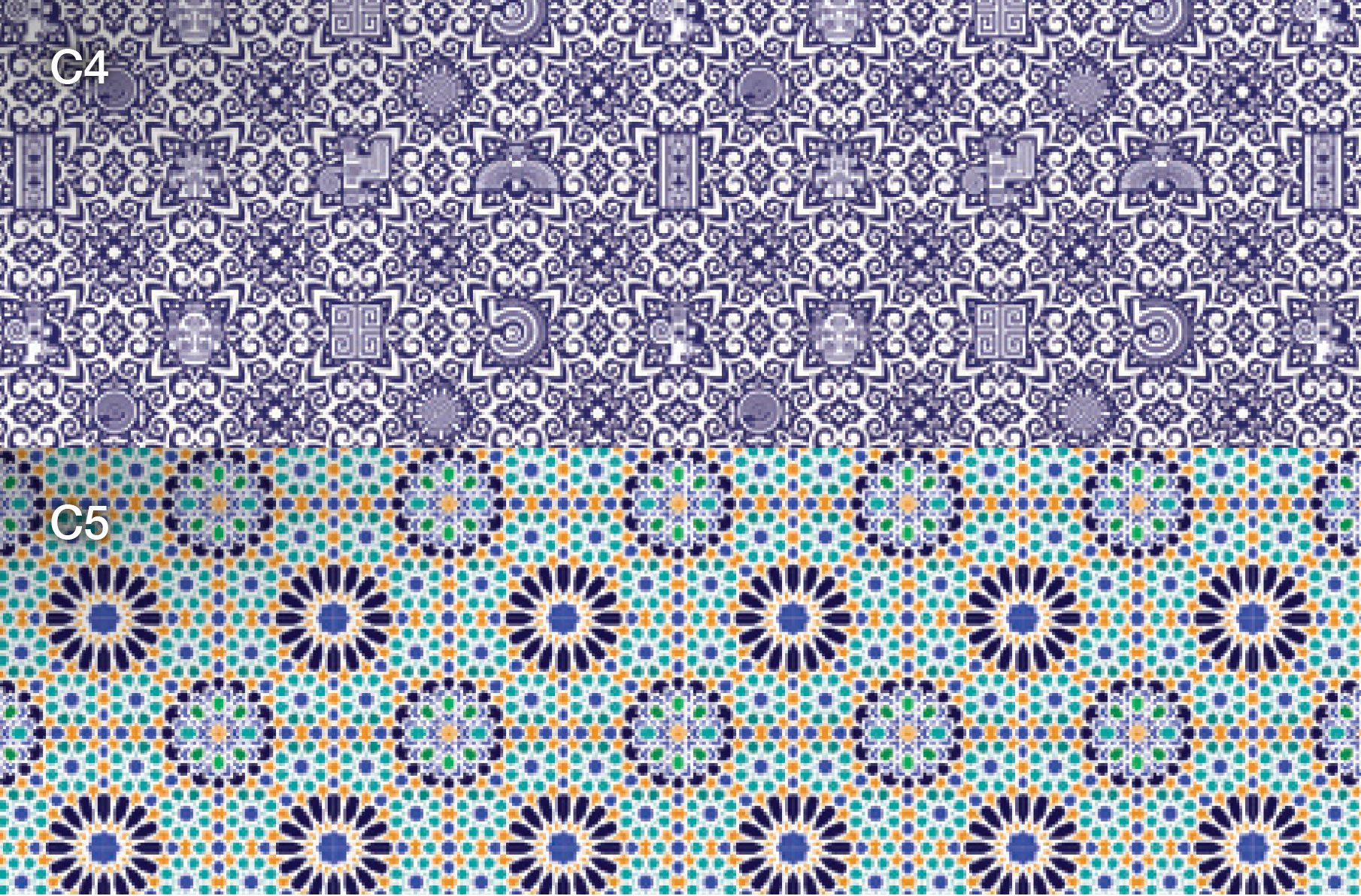
American style has been continuously enriched through cultural exchange across the Americas. Patterns C4 and C5 draw inspiration from ceramic tile traditions found throughout Mexico, Central America, South America, and the broader Mediterranean world. Incorporating floral motifs, geometric ornament, and repeating tessellations, the patterns reflect centuries of cultural exchange among Indigenous, European, African, and Islamic design traditions.
These decorative languages have become familiar elements within homes, restaurants, courtyards, public spaces, and neighborhoods across the United States. Appearing in tilework, textiles, kitchens, and living rooms, they contribute to a rich visual culture that blurs geographic boundaries and reflects the interconnected histories of the Americas. Within the installation, these patterns celebrate the role of ornament, craft, and migration in shaping contemporary American domestic environments.
21st Century: Contemporary Minimalism, Perception & Space (Room 16)
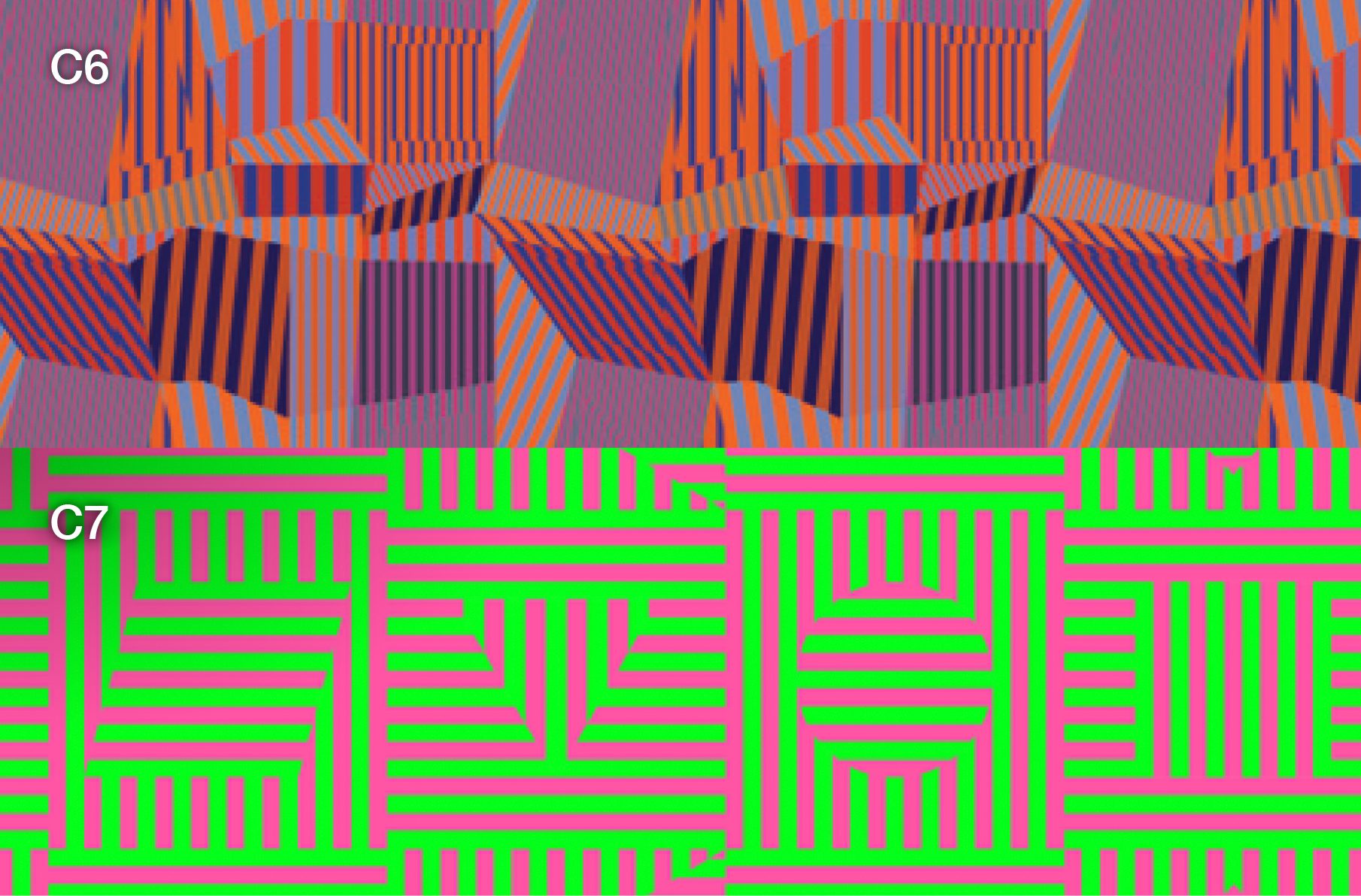
Contemporary design increasingly explores how simple visual systems can transform the perception of space. Inspired by Sol LeWitt’s Wall Drawing 1081 and the conceptual art movement, Patterns C6 and C7 employ stripes, repetition, layered grids, and optical effects to create depth, movement, and spatial ambiguity through minimal means.
While composed of simple geometric structures, the patterns shift as visitors move around them, producing changing visual experiences. Similar strategies can be found in contemporary architecture, graphic design, digital media, and interior environments, where repetition and abstraction are used to shape atmosphere rather than represent specific imagery. These patterns demonstrate how contemporary American design often prioritizes participation, perception, and interaction over decoration alone.
21st Century: Contemporary Hybridity & Personal Identity (Room 17)
The final room reflects the present moment and the artist’s own relationship to American culture. Rather than referencing a single historical movement, these patterns embrace layering, borrowing, remixing, and cultural overlap as defining characteristics of contemporary American identity.
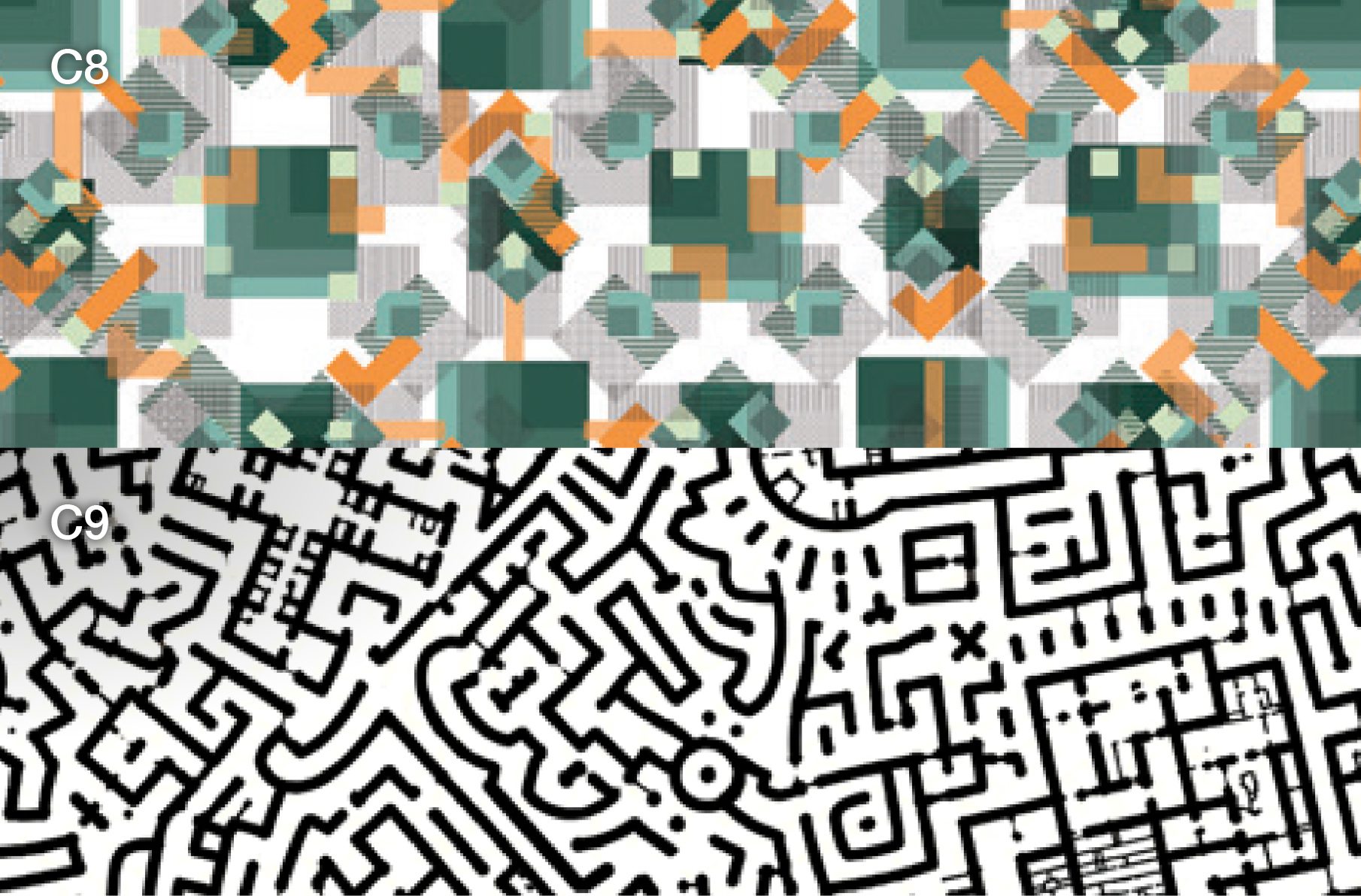
Pattern C9 draws inspiration from the energetic line work and graphic language of Keith Haring while incorporating architectural plans, urban diagrams, and spatial networks. Pattern C8 further explores layering, fragmentation, and abstraction through overlapping systems that blur the boundaries between architecture, drawing, mapping, and digital imagery. Together, the patterns reflect a contemporary condition in which identities, cultures, and influences are constantly intersecting and recombining.
As the concluding room within the installation, these patterns suggest that contemporary American style is increasingly difficult to define through a single aesthetic. Instead, it emerges through accumulation, adaptation, and continuous cultural exchange. Bringing the historical survey into the present, the room reflects both the artist’s own experience and the ongoing evolution of American culture.
ABOUT the ARTIST
Tung Nguyen is a Vietnamese architectural designer whose work engages public space as a medium for cultural exchange, community engagement, and inclusive design. Through his interdisciplinary practice, Studio Tung, he operates at the intersection of architecture, public art, and fabrication, exploring how sensory, spatial, and narrative strategies can strengthen connections between people and place. Informed by migration and extensive international travel, Nguyen brings a transnational perspective to his work, examining the ways cultural identities, histories, and environments shape the built world. His projects seek to create meaningful civic experiences through collaboration, adaptability, and engagement with local communities.
Nguyen holds a master of architecture from Columbia University’s Graduate School of Architecture, Planning and Preservation, and a bachelor of environmental design from Texas A&M University, with a minor in sustainable architecture and planning. His academic appointments have included teaching roles at Rice University, Syracuse University and Columbia University, where his courses explored formal and geometric research alongside questions of perception and neurodiversity in the built environment. Nguyen is currently a visiting lecturer at the Rice School of Architecture
As a practitioner, Nguyen has contributed to award-winning public art and architectural projects across the United States. He serves as both an artist and public art project manager, leading installations and civic interventions that center community engagement. Dedicated to design as an inclusive and transformative practice, Nguyen’s work emphasizes meaningful public participation, interdisciplinary collaboration, and the creation of spaces that foster connection and belonging.
